Watching Before Doing: How Japan's Silent Apprenticeship Tradition Exposes the Hollow Promise of American Credentials
There is a particular moment in the training of a young maiko — an apprentice geisha in Kyoto — that outsiders rarely witness and even fewer understand. She does not practice. She does not rehearse. She stands at the edge of the room, dressed in full regalia, and watches. She watches the senior geiko move, pour tea, arrange herself in conversation, and navigate the invisible social architecture of the ozashiki banquet room. No instruction is given. No rubric is distributed. She simply watches, and in watching, she begins to become.
This is minarai — literally, "learning by watching" — and it represents one of the most quietly radical pedagogical philosophies in the world. In a country where professional formation increasingly means the accumulation of certificates, licensures, and verified competencies, the minarai tradition offers a different proposition: that the deepest knowledge cannot be transmitted through language at all.
The Credential as Comfort
America has long organized its relationship with expertise around documentation. A degree from a recognized institution, a board certification, a professional license — these artifacts serve as social proof that a person has acquired a recognized body of knowledge. The logic is democratic and, on its surface, sensible: if expertise can be codified, it can be standardized, and if it can be standardized, it can be made accessible to anyone willing to invest the time and tuition.
Yet this architecture carries a hidden assumption — that the most important dimensions of professional mastery can, in fact, be codified. Increasingly, that assumption is being challenged, not only by educators and organizational psychologists, but by the quiet dissatisfaction of high-achieving Americans who hold every credential their field demands and still find themselves feeling, somehow, unprepared.
The surgeon who knows every procedure by protocol but lacks the intuitive feel of experienced hands. The therapist who has memorized every diagnostic framework but cannot yet read the room. The executive who has completed every leadership program on offer but still struggles to command genuine authority in a crisis. Credentials confirmed their competence. Something else remains missing.
What Minarai Understands That Classrooms Do Not
The Japanese concept of tacit knowledge — angoku no chishiki, knowledge that lives in the body and in the atmosphere of practice rather than on the page — sits at the heart of the minarai tradition. Philosophers of knowledge, from Michael Polanyi in the West to generations of Japanese craft masters in the East, have long recognized that expert performance relies on a dimension of knowing that resists explicit articulation.
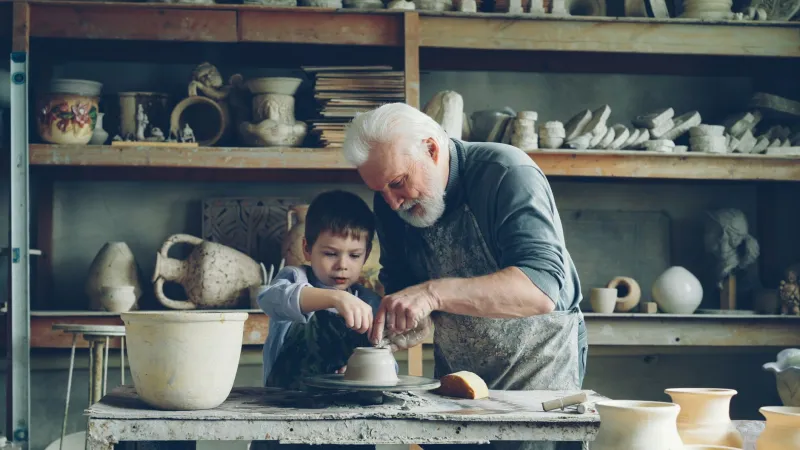
A master lacquerware craftsman in Wajima cannot fully explain why he applies pressure at a particular angle during the final polishing phase. He knows it through his hands, through ten thousand repetitions, through the feel of resistance that no manual has ever adequately described. The apprentice who stands beside him for two years before being permitted to touch the lacquer is not wasting time. He is absorbing something that a textbook cannot contain.
Minarai formalizes this understanding into a structured phase of training. In traditional arts and professions — from Noh theater to the culinary arts to the practice of medicine in certain Japanese hospital cultures — new entrants are deliberately positioned as observers before they are permitted to act. This is not hazing or gatekeeping. It is an acknowledgment that the nervous system learns differently when it is watching than when it is performing, and that certain patterns of excellence are transmitted only through prolonged, attentive proximity.
The American Encounter with Embodied Learning
Among a particular cohort of American professionals — those who have grown skeptical of the gap between their credentials and their felt sense of competence — something resembling the minarai impulse is beginning to surface.
In culinary circles, a meaningful number of trained chefs are seeking out extended stages in Japanese restaurants, not to acquire new techniques in any formal sense, but to absorb a quality of attention and precision that no culinary school curriculum has managed to convey. In martial arts communities, practitioners who have earned black belts through accelerated American programs are traveling to Japan to sit, watch, and begin again as beginners. In design and architecture firms, there is a quiet movement toward apprenticeship structures that deliberately slow down the path to independent practice.
These individuals are not abandoning their credentials. They are recognizing, often with some discomfort, that those credentials described a floor rather than a ceiling — and that the ceiling, it turns out, requires a different kind of climbing.
The Patience That Minarai Demands
It would be misleading to romanticize the minarai tradition without acknowledging what it asks of those who enter it. The maiko does not watch for an afternoon. She watches for months. The apprentice in a traditional Japanese kitchen may spend a year doing nothing but cleaning and observing before she is trusted with a knife. This is a duration of subordination that sits uneasily with American cultural values of efficiency, individual initiative, and the expectation that investment should yield prompt, visible return.
And yet the discomfort itself may be instructive. One of the things that minarai cultivates — perhaps as much as any specific skill — is the capacity to tolerate not-yet-knowing without anxiety. The ability to remain present and attentive in a state of incompleteness. This is, it turns out, one of the most important capacities in any demanding profession, and it is rarely developed by any curriculum that rewards correct answers.
Silence as Transmission
There is a phrase sometimes heard in traditional Japanese arts training: te wo mite oboeru — "learn by watching the hands." It points toward something that the minarai philosophy understands intuitively: that the teacher's hands carry information that the teacher's words cannot. The angle of the wrist. The quality of stillness before movement. The particular way that mastery looks when it is not performing mastery.
For Americans accustomed to learning environments saturated with explanation, feedback, and measurable outcomes, this silence can feel like withholding. In the minarai framework, it is precisely the opposite. The silence is the gift. It creates the conditions in which the student must develop their own powers of perception, rather than relying on the teacher's perception to be delivered to them pre-digested.
A Different Measure of Readiness
Perhaps the most enduring challenge that minarai poses to American professional culture is its implicit answer to the question: how do you know when someone is ready? In a credential-based system, readiness is determined by assessment — by demonstrated performance on a standardized measure. In the minarai tradition, readiness is recognized rather than measured. The master sees it in the apprentice's bearing, in the quality of their attention, in the almost imperceptible shift that occurs when absorbed observation begins to express itself as embodied understanding.
This recognition cannot be automated, cannot be scaled, and cannot be democratized in the way that a certification exam can. It requires a relationship of sustained proximity between someone who carries knowledge and someone who is willing to receive it on its own terms.
That relationship — patient, unhurried, built on presence rather than performance — may be the most countercultural thing that the minarai tradition has to offer a society that has grown very efficient at certifying people and very uncertain about what it means to truly know.
The voice of the way does not always announce itself. Sometimes it simply waits, in a corner of the room, to see who is paying attention.