The Sacred Uncertainty: How Japanese Mondō Teaches American Learners to Trust the Question Over the Answer
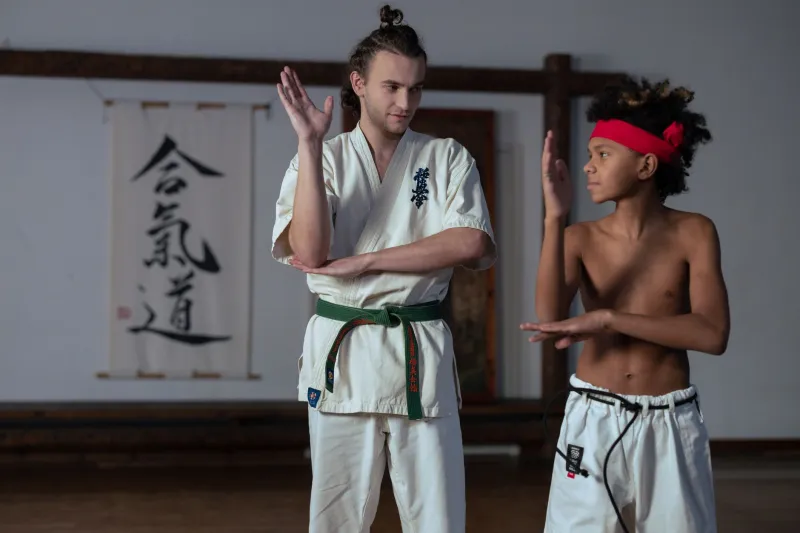
There is a particular kind of student that makes a Japanese master uneasy. Not the slow learner, nor the physically awkward beginner, nor even the one who fails repeatedly at the same technique. The student who draws the deepest concern is the one who arrives already knowing—who absorbs a correction with a confident nod and moves on before the lesson has had time to settle into the body or the mind.
In the classical Japanese teaching tradition, this eagerness to resolve uncertainty quickly is not a sign of intelligence. It is, rather, a signal that something essential has been bypassed.
The practice known as mondō (問答)—literally, "question and answer"—has roots reaching back through Zen Buddhism and into the pedagogical structures of traditional martial and artistic disciplines. At its core, mondō is not merely a teaching method. It is a philosophical stance: the belief that the quality of one's inquiry reveals the depth of one's understanding, and that premature certainty is one of the most reliable obstacles to genuine growth.
A Dialogue That Does Not Rush Toward Resolution
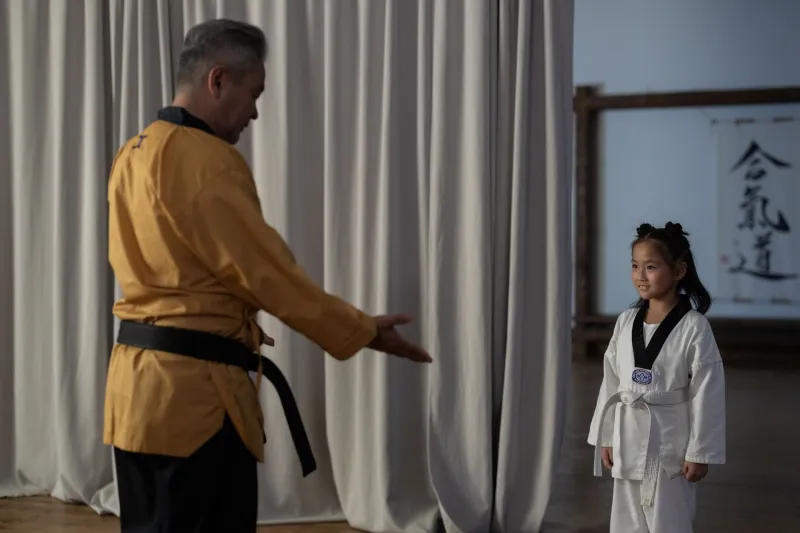
For many American learners encountering mondō for the first time, the experience is disorienting in a way that feels almost counterproductive. A student poses a question. The teacher does not answer it directly. Instead, the teacher may return a question, reframe the original inquiry, or sit in silence long enough that the student begins to feel the edges of what they thought they understood start to soften.
This is not evasion. It is precision of a different kind.
In Zen contexts, mondō exchanges between master and student were often recorded and preserved as teaching texts, not because the answers were instructive, but because the quality of the exchange itself modeled something about the nature of mind and inquiry. The student was not being led to a conclusion. The student was being trained to inhabit uncertainty with increasing steadiness—to treat the unresolved question not as a problem demanding solution, but as a threshold worth standing in.
This stands in significant contrast to the educational architecture most Americans have inhabited since childhood. From standardized testing to corporate training modules, the dominant model rewards the speed and confidence of answers. Doubt, in most American institutional contexts, reads as deficiency. The student who raises their hand to say "I'm not sure I understand" is often quietly disadvantaged compared to the one who produces a plausible-sounding response.
When Doubt Becomes a Practice
Mark Denison, a longtime aikido practitioner based in Portland, Oregon, describes a turning point in his training that came not from a breakthrough in technique, but from a conversation with his sensei that left him more confused than when it began.
"I had asked what I thought was a straightforward question about timing in a particular throw," he recalls. "My sensei listened, then asked me what I thought timing actually was. I gave an answer. He asked me to think about whether that answer applied to the breath, or only to the body. I went home genuinely unsettled. And I trained differently for weeks afterward."
What Denison experienced was mondō functioning as it was designed to: not delivering information, but restructuring the learner's relationship to what they thought they already knew. The confusion was not an obstacle to his progress. It was the progress.
This insight is gaining traction in American wellness and contemplative communities far beyond the dojo. Yoga instructors trained in traditional Indian lineages have noted strong resonances with the mondō approach, particularly in the way both traditions treat the student's internal inquiry as more pedagogically valuable than external instruction. Mindfulness teachers increasingly draw on similar principles when they encourage practitioners to "stay with the not-knowing" rather than reaching for conceptual frameworks to stabilize an uncomfortable experience.
The Question as a Measure of Readiness
In classical Japanese arts—whether calligraphy, tea ceremony, or the sword disciplines—there is a widely shared understanding that the quality of a student's questions changes as they advance. Early questions tend toward the mechanical: How do I hold this? When do I move? What is the correct form? These are necessary questions, and they receive answers. But as a student matures, the questions themselves begin to transform.
They become less about procedure and more about principle. Less about what to do and more about why certain things matter at all. A senior student in a traditional kendo dojo might eventually ask something that sounds almost philosophical—about the relationship between stillness and readiness, or about what it means to meet an opponent with an empty mind—and the teacher's response to such a question will be calibrated not just to the words, but to whether the student is genuinely prepared to receive an answer, or merely performing the posture of inquiry.
This discernment is itself a form of care. To give an answer before a student is ready to hold it is considered, in many traditional Japanese teaching contexts, a kind of disservice—like handing someone a map before they have learned to read landscape.
Permission to Not Know
For American learners shaped by productivity culture and the relentless pressure to demonstrate competence, one of the most quietly radical aspects of mondō is simply this: it grants formal permission to not know.
In a cultural environment where admitting uncertainty can feel professionally dangerous, where "I don't know" is often heard as weakness rather than honesty, the Japanese tradition of structured doubt offers something genuinely countercultural. It says, in effect, that the student who can articulate precisely what they do not yet understand is further along the path than the student who cannot locate the edges of their own knowledge.
This is not an invitation to passivity or intellectual laziness. Mondō demands rigor. It requires that a student sit with a question long enough to understand its shape—to know what kind of answer would actually satisfy it, and why. That process, repeated across years of practice, builds a particular quality of mind: one that is not easily rattled by complexity, not seduced by superficial clarity, and not in a hurry to arrive somewhere before it has genuinely departed.
Arriving at the Question
There is an old account, repeated across several Zen teaching lineages, of a student who spent three years with a master before asking his first real question. The master, it is said, wept with joy—not at the question itself, but at the evidence it contained: that the student had finally stopped pretending to understand.
For the growing number of American practitioners finding their way into traditional Japanese disciplines, this account carries a particular resonance. It suggests that the path to mastery is not a straight line from ignorance to knowledge, but something more like a slow learning to see clearly—to perceive, with increasing precision, exactly where one stands and what one does not yet know.
In that honest perception, the Japanese tradition has always maintained, something essential begins.