Light Through Leaves: How the Japanese Concept of Komorebi Is Transforming Trauma Recovery in America
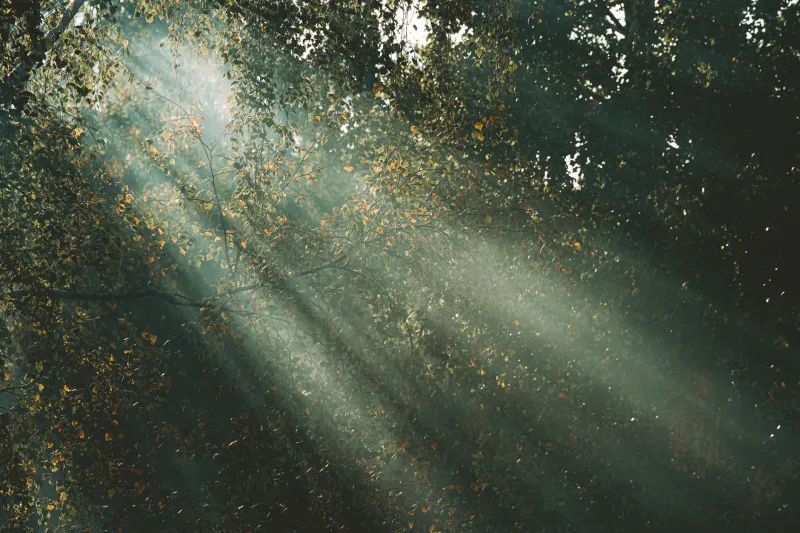
There is a moment, familiar to anyone who has stood beneath a forest canopy on a bright morning, when the wind moves the branches and the light breaks apart. It scatters. It flickers. It lands on the ground in shifting, irregular patches that seem almost alive. In Japanese, this phenomenon has a name: komorebi (木漏れ日). The word is composed of the characters for tree, leakage, and sun — and it describes something that English, for all its expressive range, has never quite managed to capture in a single term.
For centuries, Japanese poets, painters, and philosophers have treated komorebi not merely as a visual event but as a form of communication — the forest speaking in a language older than words. Today, in clinics from Portland, Oregon, to Asheville, North Carolina, that ancient conversation is being translated into the vocabulary of clinical psychology, and the implications are considerable.
Beyond the Wellness Trend: What Shinrin-Yoku Actually Means
Most Americans who have encountered the phrase shinrin-yoku (森林浴) have met it in the context of wellness marketing — a Japanese-sounding endorsement for walking among trees. The translation, "forest bathing," does little to correct this impression. The practice sounds pleasant, perhaps mildly restorative, and not entirely unlike a Saturday hike.
The original Japanese conception, however, is more disciplined and more specific. Developed by the Japanese Ministry of Agriculture, Forestry, and Fisheries in 1982 as a public health initiative, shinrin-yoku was never simply about proximity to trees. It was about sustained, attentive immersion — the deliberate absorption of the forest environment through all available senses. The practitioner does not walk briskly toward a destination. The practitioner receives.
Within that framework of reception, komorebi occupies a particular position. It is not incidental scenery. It is, according to practitioners of traditional Japanese environmental philosophy, a primary medium through which the forest communicates its essential quality of impermanence — mono no aware (物の哀れ), the bittersweet awareness that all things pass. The light does not hold still. Neither does the mind that watches it.
The Neuroscience of Dappled Light
Dr. Amara Singh, a clinical psychologist at the University of Oregon who has spent the past six years studying nature-based interventions for trauma, describes her first encounter with the research on komorebi as something of a professional surprise.
"We had been working with general green-space exposure for anxiety and PTSD," she explains. "We knew trees helped. What we did not understand was why some trees helped more than others, or more precisely, why some light conditions within forest environments produced measurably different autonomic responses."
What her team found, in collaboration with researchers at Kyoto University, was that the flickering, fractal quality of light filtering through a forest canopy — the visual irregularity that defines komorebi — activates the brain's default mode network in ways that uniform natural light does not. The effect appears to gently interrupt the hypervigilant scanning patterns associated with chronic stress and trauma, without triggering the startle response that sudden visual changes typically provoke.
"The nervous system seems to recognize this particular quality of light as safe," Dr. Singh notes. "It is movement, but it is not threat. The brain processes it differently from, say, a flickering fluorescent light, which can actually increase cortisol. Komorebi appears to do the opposite."
This distinction matters enormously in clinical contexts. For patients with post-traumatic stress disorder, the environment of recovery must navigate a narrow passage: stimulating enough to interrupt rumination, calm enough to avoid re-traumatization. Dappled forest light, the research suggests, may occupy that passage with unusual precision.
From the Forest Floor to the Corporate Recovery Program
The clinical applications of komorebi are not confined to trauma treatment. In the corridors of American corporate wellness — a sector that has grown dramatically in response to the burnout epidemic accelerating since 2020 — Japanese forest philosophy is finding an unexpected institutional home.
Several large employers in the Pacific Northwest and the Northeast have begun incorporating structured shinrin-yoku sessions, with explicit attention to komorebi as a focal practice, into their employee mental health programming. The sessions are facilitated by certified guides, a profession that has grown substantially in the United States over the past four years, with training programs now operating in at least fourteen states.
Katherine Moreau, a certified forest therapy guide based in Vermont who trained with the Association of Nature and Forest Therapy, describes the corporate context as both rewarding and philosophically demanding.
"Executives arrive with their phones and their productivity metrics," she says. "They want to know how many minutes of forest time equals how many points of cortisol reduction. That is understandable. But the practice asks something different of them. It asks them to stop measuring and start noticing. Komorebi is a good entry point because it is beautiful enough to arrest attention without requiring any prior knowledge or belief."
The results, she reports, tend to surprise participants accustomed to quantifiable outcomes. "Something shifts when people actually stop and watch the light move through the leaves. You can see it happen. The shoulders drop. The jaw unclenches. They are no longer performing relaxation — they are experiencing it."
A Philosophy of Attention, Not Escape
It would be a misreading of Japanese environmental philosophy — and a disservice to the practitioners who carry it — to reduce komorebi to a therapeutic technique. The concept belongs to a broader aesthetic and philosophical tradition that does not separate the beautiful from the true, or the sensory from the ethical.
In the Japanese aesthetic framework, attention to phenomena like komorebi is a form of practice in itself — a cultivation of what might be called perceptual humility. The light through the leaves is not there for the observer's benefit. The observer is, for a moment, simply present to something that exists independent of human need or interpretation. This is, in the vocabulary of Zen, a small but genuine encounter with mu (無) — the experience of not-self, of the boundary between perceiver and perceived becoming briefly permeable.
For American practitioners working at the intersection of Japanese philosophy and Western psychology, this dimension presents both a challenge and an opportunity. The clinical language of nervous system regulation is useful, even necessary, for institutional adoption. But it can also flatten what it describes.
"We are careful," says Dr. Singh, "not to reduce komorebi to a stimulus-response mechanism. The Japanese tradition is pointing at something more fundamental — a different relationship between the human being and the natural world. The neuroscience supports the practice. It does not exhaust its meaning."
The Way the Light Falls
In a culture that has grown accustomed to seeking wellness in apps, supplements, and structured programs, the idea that healing might arrive through the unstructured movement of sunlight through leaves can seem almost implausibly simple. Yet the evidence, both ancient and contemporary, points insistently in that direction.
The voice of the way — michi no koe — is not always loud. Sometimes it is precisely this: light breaking apart as it passes through something living, landing on the ground in patterns no algorithm could predict, asking nothing of the person who watches except that they remain, for a moment, present to what is actually there.
In forests from the Cascades to the Appalachians, Americans are beginning, slowly, to listen.