Hands in the Grain: Why Young Americans Are Seeking Mastery in Traditional Japanese Craft
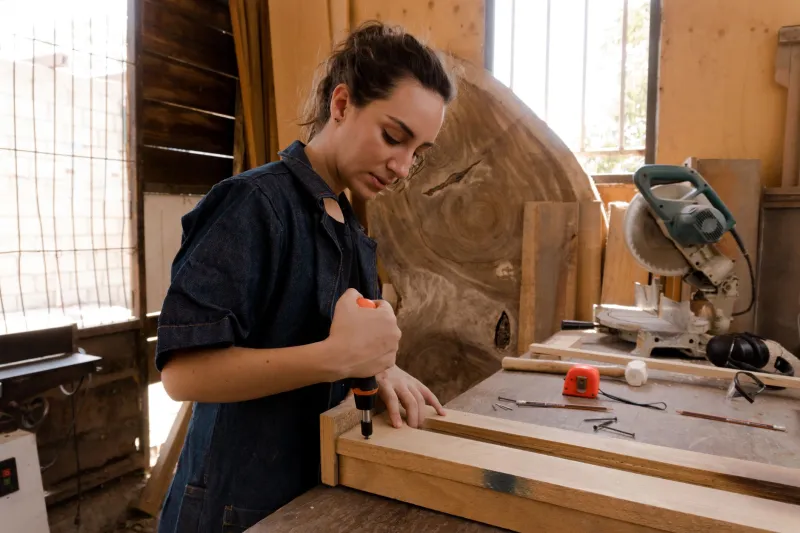
The first time Renata Osei tried to fold a sheet of washi by hand, she tore it. The second time, she tore it again. By her own account, she spent the better part of a Saturday afternoon in a Portland community workshop destroying paper that a Japanese artisan would have shaped in under a minute — and she found the experience, she says, "strangely necessary."
"I think I needed to fail at something that wasn't a spreadsheet," she explains. "Something where the failure was real and physical and I could hold it in my hands."
Osei, a 31-year-old graphic designer, is not an outlier. Across the country — in studio apartments in Brooklyn, garage workshops in Austin, and dedicated makerspaces in cities from Denver to Minneapolis — a growing number of Americans in their twenties and thirties are turning to traditional Japanese craft disciplines with a seriousness that goes well beyond weekend curiosity. They are learning the geometry of sashimono joinery. They are pulling fiber through vats of indigo dye in the centuries-old aizome tradition. They are studying the structural logic of shoji screen construction and the compositional restraint of urushi lacquerwork. And they are finding, in these exacting practices, something that contemporary life has made surprisingly rare: the experience of genuine difficulty encountered with genuine patience.
The Texture of the Real
To understand why these disciplines are attracting serious attention now, it helps to understand what they are not. They are not quick. They are not forgiving. And they are emphatically not optimized for the production of shareable content, though social communities built around Japanese craft have flourished on platforms including YouTube, Reddit, and Instagram, where channels dedicated to hand-tool woodworking and natural dyeing regularly attract hundreds of thousands of followers.
What the disciplines of traditional Japanese craft offer, in contrast to the ambient texture of digital life, is a form of engagement that is irreducibly physical and irreversibly sequential. Wood has grain, and the grain has direction, and if you cut against it you will know immediately. Paper fiber behaves according to principles that cannot be overridden by a keyboard shortcut. The indigo vat requires temperature management, pH monitoring, and a patience that the dye itself enforces — rush it, and the color will tell you.
For a generation that has spent its formative years in environments where errors are undoable and feedback is instantaneous, this quality of material resistance is, paradoxically, a form of relief.
Community as Curriculum
The infrastructure through which young Americans are accessing these traditions is itself a study in creative adaptation. Formal apprenticeships with Japanese master craftspeople remain rare and geographically limited, but an ecosystem of boutique workshops, translated instructional texts, and tightly moderated online communities has emerged to fill the gap.
Workshops specializing in Japanese joinery and hand-tool woodworking — offering weekend intensives and multi-week immersive courses — have proliferated in cities including San Francisco, Asheville, and Chicago. Organizations dedicated to Japanese papermaking have established residency programs in the Pacific Northwest. Natural dyeing studios teaching shibori resist techniques and plant-based color traditions have developed loyal followings in the urban South and Northeast.
Online, communities devoted to these practices operate with a degree of rigor unusual for hobbyist spaces. Members post work-in-progress documentation, invite critique, and engage in extended discussions of technique and philosophy. The tone is notably different from the celebratory sharing culture of mainstream social media — closer, in some ways, to the ethos of a traditional workshop, where excellence is the assumed standard and honest assessment is understood as a form of respect.
The Ritualistic Dimension
What practitioners consistently describe — and what distinguishes their engagement from ordinary hobby interest — is an experience of craft as something closer to practice in the contemplative sense. The preparation of tools. The sequencing of steps that cannot be reordered. The sustained attention required to execute a single joint or achieve an even pull of fiber through a screen. These are not merely technical demands; they are, in the experience of those who pursue them seriously, a form of structured presence.
This quality is not incidental to the Japanese craft traditions in question. Many of these disciplines developed within or alongside Buddhist and Shinto contexts in which the manner of making was understood to be as significant as the object made. The shokunin — the Japanese term for a craftsperson who has achieved a level of mastery that encompasses both technical excellence and philosophical commitment — is not simply skilled. The shokunin is, in a meaningful sense, formed by the practice.
American practitioners working outside that cultural context are finding their own language for this dimension of the experience. Words like "grounding," "meditative," and "centering" appear frequently in how they describe sustained work with traditional tools and materials. The vocabulary is contemporary and secular, but the underlying experience — of being returned to the body, to the present moment, to a scale of time that resists acceleration — connects to something the Japanese craft tradition has always known.
Making Against the Current
There is also, for many practitioners, an explicitly countercultural dimension to the choice. Mass production has made objects cheaper and more abundant than at any previous point in human history. Fast fashion, flat-pack furniture, and algorithmically curated consumer goods have normalized a relationship to material things characterized by low attachment and rapid turnover. To spend forty hours learning to cut a single dovetail joint — to make something that will outlast you, that bears the evidence of your particular hands — is to refuse, quietly but deliberately, that logic.
This refusal is not nostalgic in any simple sense. The young Americans drawn to Japanese craft traditions are not seeking to inhabit the past. They are seeking, in the accumulated intelligence of those traditions, tools for navigating a present that their own culture has left them poorly equipped to inhabit. The discipline, the patience, the willingness to be a beginner in the presence of something genuinely difficult — these are the qualities that the way of craft, like the way of any serious practice, asks of those who enter it.
The grain of the wood does not care about your credentials. The fiber does not respond to urgency. And in that indifference, something essential is offered: the chance to be fully, quietly, usefully present.