The Nose Knows the Way: Kōdō and the Discipline of Olfactory Attention
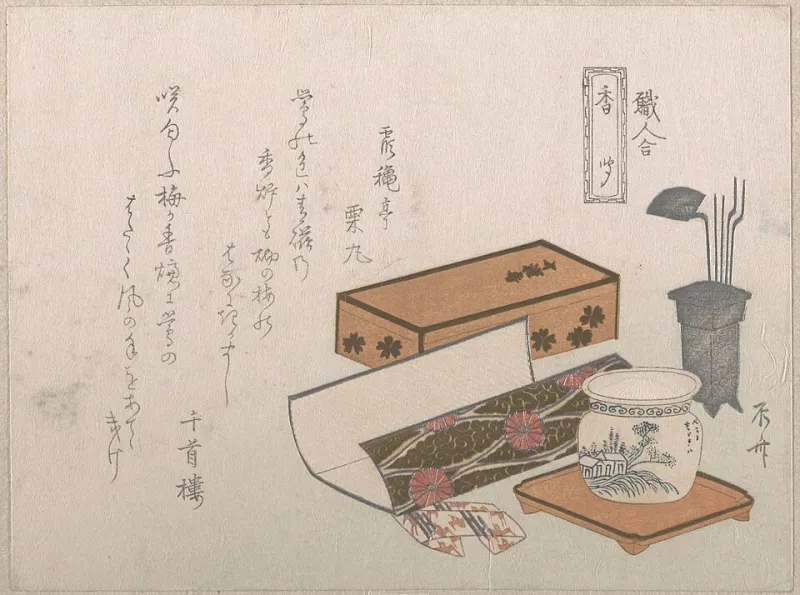
Photo: Ryūryūkyo Shinsai, CC0, via Wikimedia Commons
In a rented studio in Portland, Oregon, a dozen adults sit in a loose semicircle. There is no mat, no cushion, no guided visualization. On a low table at the center, a small ceramic cup holds gray ash, a piece of charcoal, and a sliver of aromatic wood. The room is quiet enough to hear a coat sleeve brush against a chair. The instructor does not ask anyone to relax. The instruction is simpler and more demanding: listen.
This is kōdō, the Japanese way of incense, and it is arriving in the United States through a narrow door. Not as perfume, not as aromatherapy, and not as another mood-enhancing accessory for the wellness industry. In a handful of studios, cultural centers, and sensory-awareness workshops from Portland to Brooklyn, kōdō is being taught as a discipline of attention. Its material is scent. Its method is patience. Its setting is a group of people who agree to be quiet together.
An Art of Listening, Not Scent
Kōdō is often translated as "the way of fragrance," but the translation can mislead. The practice does not begin with a pleasant smell. It begins with preparation: ash is smoothed, charcoal is buried, mica is placed, and a small chip of aromatic wood is heated indirectly. The wood does not burn. It releases its scent slowly, in stages, like a sentence spoken at a deliberate pace.
The participant's task is not to enjoy the fragrance but to attend to it. Which notes appear first? Which fade? How does the same wood smell different after several minutes, or in a different room, or to a different person? Some schools include games in which participants match scents or identify distinctions among several woods. The game is not a competition in the ordinary sense. It is a way of training the nose to make finer and finer distinctions.
For Americans saturated with visual stimuli, this can be disorienting. We are accustomed to looking, scrolling, checking, and comparing. Kōdō asks us to close the visual loop and rely on a sense that is usually background noise. The result is not a mystical experience. It is closer to learning a musical instrument. At first, everything smells like wood. Later, the differences become unmistakable.
The Discipline of Waiting
Much of kōdō is waiting. The charcoal must reach the right temperature. The ash must be shaped without being compacted. The incense must be given time to open. A beginner who expects immediate feedback will feel the delay as friction. A beginner who accepts the delay will begin to notice something else: the scent has a beginning, a middle, and an end.
This is where kōdō separates itself from the familiar language of modern wellness. It is not a relaxation technique, though relaxation may occur. It is not a mindfulness exercise, though attention is central. It is a practice of discernment. The nose is asked to do what the eyes normally do: compare, remember, and describe. The vocabulary is small at first. Words like sweet, dry, resinous, and powdery are placeholders. Over time, the vocabulary becomes more precise, not because the practitioner has learned a secret list of terms, but because the nose has learned to notice more.
Group silence adds a social dimension that is easy to miss. In American life, silence among strangers often feels like a failure of conversation. In kōdō, silence is the shared condition of attention. No one is performing. No one is waiting for a turn to speak. The group is united by a common object of attention, and that unity is quiet.
Why American Studios Are Curious
Wellness studios have been drawn to kōdō for reasons that are partly practical and partly philosophical. The practice requires little equipment, no screens, and no physical exertion. It can be adapted to a small room. It also addresses a complaint that many facilitators hear: clients are tired of being told to breathe, visualize, and optimize. Kōdō offers a different entry point. It does not ask participants to change their thoughts. It asks them to smell carefully.
That difference matters. Visual culture trains Americans to evaluate surfaces. Kōdō trains another kind of judgment, one that unfolds over time. A scent cannot be paused or screenshotted. It arrives and departs. The practice therefore teaches a form of patience that is not passive. It is active waiting, the kind of waiting that notices.
There are risks, of course. Japanese cultural practices can be flattened when they are imported into the American wellness market. Kōdō has lineages, protocols, and standards that deserve respect. A studio that presents incense as a decorative mood setter is not teaching kōdō. It is selling atmosphere. The more serious adopters are cautious. They invite teachers with formal training. They explain the difference between heating and burning. They resist the temptation to promise outcomes.
What It Asks of a Beginner
A beginner does not need to become Japanese. Nor does a beginner need to believe anything in particular. The practice asks for a modest set of commitments: arrive on time, sit still, do not rush the scent, do not perform expertise, and do not turn the experience into a score. The lack of a score is important. In a culture that measures progress in streaks, badges, and before-and-after photos, kōdō offers no dashboard. The only evidence of progress is a finer quality of attention.
That evidence is real, but it is private. You may notice that you can distinguish two woods that once seemed identical. You may notice that you are less eager to fill a silence. You may notice that a smell in an ordinary room suddenly has structure. None of these results can be posted. They belong to the person who practiced.
At the end of a session, the incense fades. The room does not applaud. Participants bow, collect their things, and return to a world of screens and noise. The practice does not promise to make that world disappear. It offers something narrower and more durable: a trained nose, a quieter group, and a few minutes in which attention was not a resource to be spent but a capacity to be explored.