Gold in the Cracks: Is America's Kintsugi Boom a Philosophy or a Mood Board?
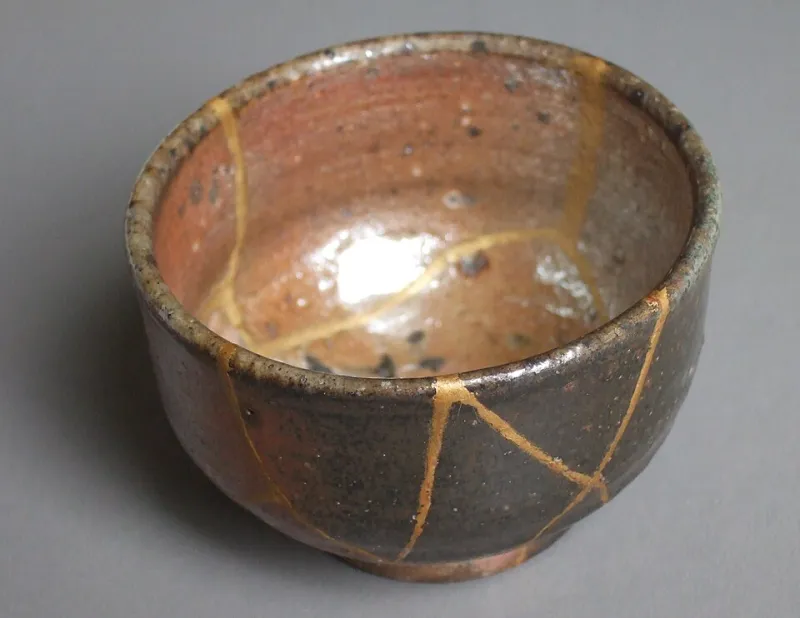
Photo: Haragayato, CC BY-SA 4.0, via Wikimedia Commons
Here is the scene, now familiar in at least a dozen American cities: a long wooden table, a row of participants who paid between sixty-five and two hundred dollars for the evening, a broken ceramic bowl at each seat, and a teacher explaining urushi lacquer while someone films a reel for Instagram with the caption "healing era."
Kintsugi — the Japanese practice of mending broken pottery with lacquer dusted in gold — has arrived in the United States, and it has arrived loudly. Workshops in Brooklyn sell out within hours. Portland studios run weekly sessions. Austin hosts corporate team-building kintsugi, because of course it does. The philosophy writes its own marketing copy: breakage is part of an object's history; repair it visibly; honor the crack rather than hide it.
As an argument against throwaway culture and curated flawlessness, this is genuinely powerful. As a mass phenomenon, it deserves more scrutiny than it is getting.
What the Practice Actually Asks
Traditional kintsugi is not an evening activity. Authentic urushi lacquer is derived from tree sap, causes allergic reactions in most first-time handlers, and requires weeks of humidity-controlled curing between applications. A proper repair can take two to three months. The gold is applied last, and sparingly, because the point is not decoration — it is the continuation of a functional object's life with its injury honestly recorded.
Most American workshops, for entirely practical reasons, use food-safe epoxy and mica powder. The bowl is finished in ninety minutes. This is not necessarily a scandal — adaptation is how traditions travel — but it does change the thing. A practice whose central teaching is patience, whose literal medium is time, is being delivered in a format whose central feature is immediacy. The contradiction is not cosmetic. It is structural.
The Master's Doubt
Japanese practitioners have noticed. One Kyoto-trained restorer, speaking at a cultural exchange event on the West Coast, offered a measured but pointed observation: kintsugi was never about feeling better. It was about an object. The emotional resonance — the famous metaphor of scars made beautiful — is a reading that grew up around the craft, much of it from outside Japan. The craft itself is quieter and stricter: repair the bowl well, repair it honestly, and do not pretend the break never happened.
When American workshops lead with the metaphor and treat the object as a prop, some masters argue, the hierarchy is inverted. The bowl becomes a vehicle for a feeling the participant already wanted to have. That is not philosophy. That is therapy with better props.
The Case for the Boom
And yet — the contrarian take cuts both ways, and honesty requires the other side.
The American practitioners I spoke with are not naive. A teacher in the Hudson Valley who runs monthly sessions acknowledged the epoxy problem outright: "I tell every class, this is kintsugi-adjacent. If you fall in love with it, find real urushi. Some do." Several students described the workshop as a gateway — to repair culture generally, to visible mending of clothing, to fixing appliances instead of replacing them. In a country that discards roughly fifty million tons of material goods a year, a ritual that makes repair feel meaningful rather than shameful is not trivial, whatever lacquer it uses.
There is also the matter of who profits. Concerns about appropriation are legitimate when a culture's practice is extracted and sold back without credit or benefit. But many of the fastest-growing American workshops are run by Japanese and Japanese-American teachers, some trained in Japan, who see the boom as an opening rather than a theft — a chance to teach the real practice to people who would never otherwise encounter it.
Movement or Mood Board?
So which is it: a movement or a mood board?
The honest answer is that it is currently both, and the ratio is undecided. Kintsugi's American moment contains the same tension as every imported practice before it — yoga in the 2000s, meditation apps in the 2010s. The commercialized version is thinner, faster, and sometimes hollow. But it also recruits. Some fraction of the people who come for the Instagram moment stay for the lacquer, the months of curing, the discipline. The mood board, given time and good teachers, can become a doorway.
The test is not whether a workshop uses epoxy. It is whether anyone in the room leaves understanding that the gold was never the point. The point is a refusal — a small, deliberate refusal to discard, to conceal, to pretend wholeness was ever the absence of damage. That refusal can be learned in ninety minutes with mica powder. Whether it is lived afterward, in a culture built on upgrades, is the only measure that matters.
The bowl, at least, is not in a hurry. It has been broken before. It can wait to see what we do with the crack.