Gardens That See You Back: How Japanese Spatial Design Is Rewiring American Perception
There is a particular kind of discomfort that arrives, uninvited, when an American visitor steps into a traditional Japanese garden for the first time. The phone is raised. The frame is composed. And then something stalls. The garden refuses to resolve into a photograph. It seems to withdraw from documentation, not because it lacks beauty, but because its beauty operates on a register that the camera cannot reach.
This is not an accident. It is, in fact, the point.
Designed to Disorient the Habitual Eye
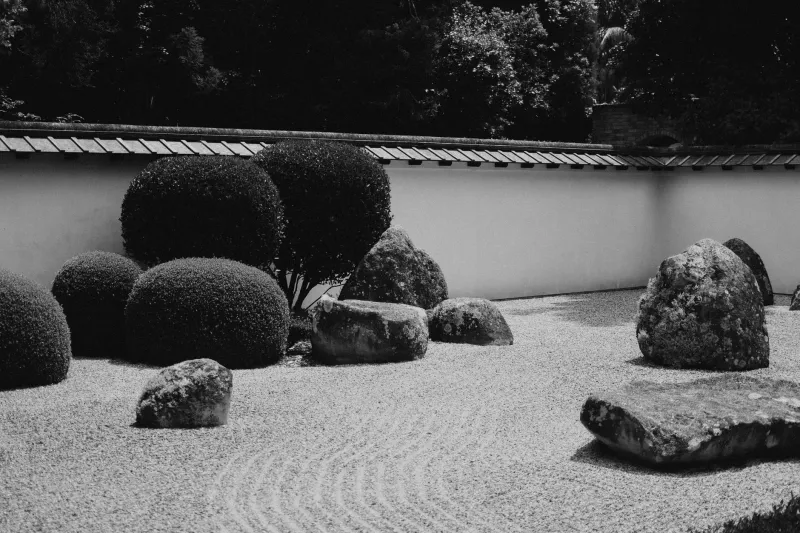
The great garden traditions of Japan—karesansui, or dry landscape gardens; the stroll gardens of the Edo period; the moss-carpeted precincts surrounding ancient temple compounds—were composed according to principles that Western landscape design has rarely attempted. Where European formal gardens impose symmetry and legibility, Japanese gardens engineer a deliberate ambiguity. Borrowed scenery, known as shakkei, pulls distant mountains or tree lines into the composition without naming them. Paths curve to delay arrival. Stone arrangements suggest water without containing it.
The effect on perception is not decorative. It is corrective.
Miegakure—the principle of hide-and-reveal—ensures that no single viewpoint exhausts a garden's content. Walk three steps and the composition shifts entirely. Stand still and the light recomposes around you. The garden does not present itself. It negotiates.
For a visitor whose perceptual habits have been formed by social media feeds, highway billboards, and the ambient visual acceleration of American commercial culture, this negotiation can feel genuinely disorienting. Several visitors to Kyoto's Ryoan-ji have described the experience of sitting before its famous rock garden not as peaceful, but as quietly confrontational—as though the space were waiting for them to stop performing attention and begin actually practicing it.
The Silence That Is Not Quiet
One of the more misunderstood qualities of Japanese gardens is their relationship to sound. Western visitors frequently describe them as silent. Japanese garden designers and scholars would likely disagree.
The sound of raked gravel beneath a slow footstep. Water falling at a calculated distance, heard but not yet seen. Wind moving through a stand of bamboo in a rhythm that resists prediction. These are not incidental qualities. They are composed elements, as deliberately placed as any stone.
The tradition of suikinkutsu—an inverted buried pot that amplifies the sound of dripping water into something resembling a subterranean bell—illustrates the principle with unusual clarity. The device is invisible. Its effect is entirely acoustic. The visitor who discovers it must stop, listen with genuine attention, and then recalibrate what they thought they understood about the space around them.
This is listening with the eyes. It is the cultivation of a cross-sensory attention that Japanese aesthetic philosophy has long considered a mark of genuine perception—the capacity to hear what a space is doing, not merely see what it contains.
What American Nature Tourism Does Not Offer
The American relationship with natural environments has grown increasingly transactional. National parks log visitor counts in the tens of millions. Instagram geotags direct traffic to formerly quiet overlooks until those overlooks require timed entry permits. The language of nature engagement in American wellness culture tends toward accumulation: more trails hiked, more summits reached, more species identified.
Japanese garden culture proposes a fundamentally different economy. The garden at Kokedera—the Moss Temple in Kyoto—requires advance written application for entry. Visitors are asked to copy sutras before walking the grounds. The friction is intentional. It converts the visit from consumption into preparation.
American practitioners and landscape architects who have studied these traditions at length describe the underlying philosophy as one of reciprocal attention. The garden gives in proportion to what the visitor brings. Bring distraction, and the garden remains a pleasant backdrop. Bring stillness, and the garden begins to speak in a vocabulary that no guidebook translates.
Several therapeutic garden projects now operating in the United States—at hospitals, rehabilitation centers, and trauma recovery facilities in California, New York, and the Pacific Northwest—have drawn explicitly on this philosophy. Their designers speak not of creating beautiful spaces but of engineering conditions for a particular quality of presence. The goal is not relaxation in the passive sense. It is the restoration of perceptual capacity in people whose ability to attend to their immediate environment has been eroded by illness, grief, or chronic stress.
Retraining the Direction of Attention
The Japanese concept of mitate—seeing one thing as another, or perceiving multiple meanings within a single form—runs through garden design as a constant undercurrent. A stone is a stone. It is also a mountain, a resting animal, a word in an unspoken sentence. The garden does not explain this. It simply arranges conditions under which the visitor may discover it, or may not.
This is attention trained to move inward rather than outward. In a culture that has largely externalized perception—outsourcing it to screens, to algorithms, to the curated recommendations of platforms built on behavioral prediction—the invitation is genuinely countercultural.
It is also, for many Americans who encounter it seriously, something close to revelatory.
A landscape architect based in Portland, Oregon, who spent three years studying garden design in Japan, described the shift in her own perception this way: she had spent years learning to look at spaces. The gardens taught her, slowly and without instruction, to allow spaces to look back. The distinction sounds abstract until it is experienced. Then it becomes, she said, nearly impossible to reverse.
The Garden as Teacher Without Words
The editorial tradition of this publication has long held that the deepest Japanese arts do not explain themselves. They arrange conditions. They establish a quality of environment. And then they wait.
The garden is perhaps the purest expression of this pedagogy. It does not lecture. It does not offer a curriculum. It simply exists with a precision and intentionality that rewards the visitor who arrives willing to be changed by the encounter rather than merely enriched by it.
For Americans navigating a culture of constant stimulation, relentless documentation, and the low-grade exhaustion that follows from both, this is not a small offer. It is, in its quiet way, a radical one.
The garden asks only that you stop trying to see it—and allow yourself, for a time, to be seen.