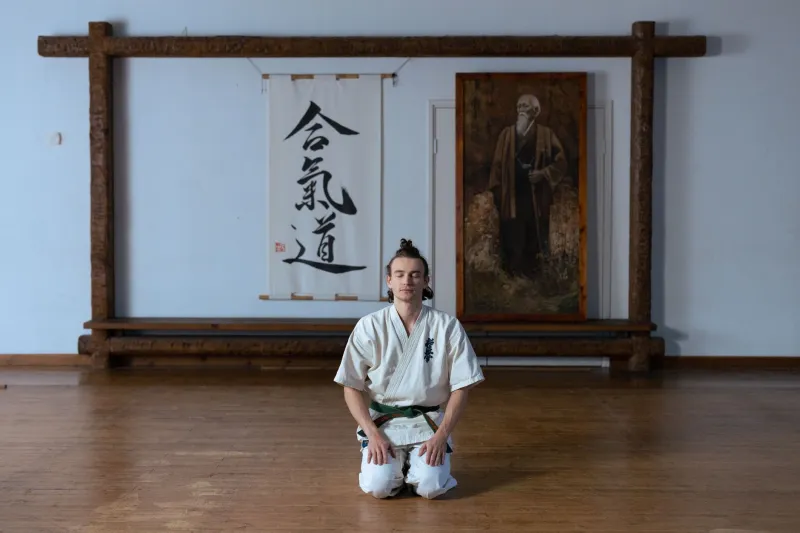
From the Dojo to the Boardroom: Ancient Warrior Disciplines Are Rewriting the Rules of Tech Leadership

Inside the offices of some of America's most ambitious technology companies, a quiet philosophical revolution is underway. Executives and founders are increasingly turning to the principles of Japanese martial tradition — bushido's ethical architecture, the repetitive precision of kata, the stillness cultivated through Zen practice — to navigate the pressures of modern innovation culture. This is not a trend in corporate wellness programming. It is something considerably more serious.
A Different Kind of Competitive Edge
Silicon Valley has long been hospitable to unconventional frameworks for performance. Stoicism, cognitive behavioral techniques, and various contemplative practices have each had their moment among the startup class. What distinguishes the current interest in Japanese martial philosophy is its depth of engagement. A growing cohort of technology leaders are not merely reading about bushido or attending a weekend seminar on Zen; they are training in dojos, studying classical texts, and applying the conceptual vocabulary of martial tradition to organizational problems with genuine rigor.
The appeal, many of them report, is not aesthetic or cultural — it is structural. Japanese martial philosophy offers something that mainstream business education rarely does: a coherent ethical framework integrated with a practical methodology for decision-making under pressure. In an industry where the consequences of poor judgment can be enormous and rapid, this combination proves unexpectedly relevant.
Kendo, the way of the sword, has attracted particular interest among executives in the Bay Area and in technology hubs from Seattle to Austin. Several practitioners describe the sport's central discipline — the capacity to maintain composure, read an opponent's intent before it manifests, and commit fully to a strike while remaining open to adaptation — as a direct analogue to the demands of competitive strategy. The shinai may be made of bamboo, but the lessons it teaches are anything but soft.
The Ethics of Bushido in an Age of Disruption
Bushido — the warrior's way, a code that evolved over centuries of Japanese feudal culture and was later systematized in texts such as Nitobe Inazo's 1900 treatise — is built around a set of interlocking virtues: rectitude, courage, benevolence, respect, honesty, honor, and loyalty. These are not abstract aspirations. In the martial context from which they emerged, they were operational principles whose violation carried immediate and serious consequences.
For technology leaders operating in an environment where ethical lapses have produced some of the most consequential corporate failures of the past decade — from data privacy scandals to algorithmic harms — the rigorous ethical architecture of bushido offers a framework with genuine teeth. Several founders interviewed for this article described bushido not as a set of values to be displayed on a mission statement but as a daily practice of self-examination: asking, before each significant decision, whether the action under consideration reflects gi (rectitude) and makoto (sincerity).
One chief executive at a mid-sized software company in San Francisco, who has practiced judo for over fifteen years, described the influence in concrete terms: "Judo teaches you that the most powerful move is often not the most forceful one. You learn to use the energy that comes at you rather than resist it. I apply that to competitive pressure, to difficult conversations with investors, to moments when the instinct is to push back hard. The discipline asks you to pause and find the leverage point instead."
This orientation — toward economy of force, toward reading rather than overpowering a situation — recurs consistently across conversations with martial-arts-practicing executives. It runs counter to the culture of aggressive disruption that has historically defined Silicon Valley's self-image, and that tension appears to be part of the appeal.
Kata as a Framework for Creative Mastery
Beyond ethics, the training methodology of Japanese martial arts has attracted attention for what it reveals about the relationship between discipline and creativity. Kata — the precisely choreographed sequences of movement practiced repeatedly in arts such as karate, aikido, and kendo — are frequently misunderstood by Western observers as rote memorization: the opposite of creative thought. Practitioners understand them differently.
Kata encode the accumulated wisdom of generations of martial artists in a form that can be transmitted across time and culture. Through repetition, the practitioner internalizes principles that eventually become available not as consciously retrieved rules but as embodied intuition. Mastery, in this framework, is not the ability to execute a fixed sequence flawlessly — it is the freedom that emerges when foundational principles have been absorbed so completely that the practitioner can respond to novel situations without deliberation.
This understanding of the relationship between constraint and creativity has found receptive audiences in product development and design circles. Several UX designers and product managers at major technology companies have begun incorporating kata-inspired practice frameworks into their work — creating highly structured daily routines for the most foundational aspects of their craft precisely in order to free cognitive resources for higher-order problem-solving. The paradox that rigid discipline can be a precondition for genuine innovation is one that martial tradition has understood for centuries; it is arriving, somewhat belatedly, in the culture of tech.
Stillness as Strategy
Zen influence — always present in the background of Japanese martial arts — has become more explicit in how many technology leaders describe their practice. The cultivation of mushin (no-mind), a state of alert, non-grasping awareness that martial artists train to access in competition, maps with surprising fidelity onto what cognitive scientists describe as the conditions most conducive to insight and creative problem-solving. The absence of anxious rumination, the capacity to hold multiple possibilities without premature closure, the ability to act decisively without attachment to outcome: these are qualities that Zen and neuroscience describe, from different angles, in remarkably similar terms.
Meditation programs rooted in Zen tradition have proliferated in corporate settings for years, but the martial arts offer something additional: a physical, high-stakes context in which these capacities are tested in real time. You cannot think your way through a kendo match. The practice makes demands that no amount of conceptual understanding can satisfy, and it is precisely this quality — the insistence on embodied, applied wisdom rather than theoretical knowledge — that many executives find transformative.
The michi — the way — implied in disciplines such as kendo, judo, and aikido is not a destination but an ongoing practice of refinement. For technology leaders accustomed to measuring progress in quarterly cycles and product releases, this temporal orientation represents a genuine philosophical challenge. Several describe it as one of the most valuable reframings their martial practice has offered: the understanding that the most important forms of development do not yield to urgency, and that the leader who cultivates patience may ultimately move faster than the one who mistakes speed for progress.
The dojo and the boardroom are separated by more than geography. But the questions they ask of those who inhabit them — Who are you under pressure? What do you stand for when standing for something is costly? How do you act with full commitment while remaining open to what you cannot yet see? — are, it turns out, the same questions.